
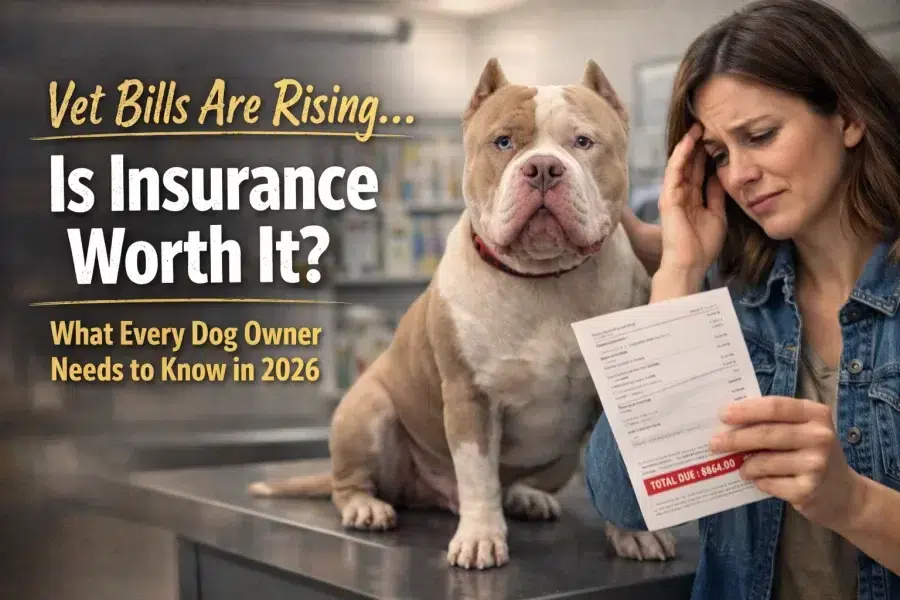
According to the AVMA, dog owners spent an average of $580 on veterinary care in 2024, but that figure does not include emergency care. A single unexpected procedure can cost several times that amount on a single visit.
For most dog owners, bills at that level arrive without warning and without a plan. When the moment comes, the decision about how to proceed is made under emotional pressure rather than financial confidence.
Pet insurance for dogs can ease that pressure. Instead of scrambling to find funds in a crisis, insured dog owners can focus entirely on getting their dog the care it needs. This article breaks down what pet insurance actually covers, what it costs, and whether it makes sense for your dog.
A lot of the examples here are drawn from large breeds like the American Bully, but the financial realities apply to any dog owner. The breed changes the specific numbers; the core principle stays the same.
How Much Does it Really Cost to Own a Dog?
Most new dog owners budget for the obvious things: food, a bed, a collar, and a few toys. What tends to catch people off guard is the ongoing cost of keeping a dog healthy, especially as they age.
Here is a realistic breakdown of what most dog owners can expect to spend each year on routine care. The American Veterinary Medical Association reports that the average veterinary visit for dog owners costs about $220 in 2025, highlighting how expensive routine care has become.

These costs are predictable and manageable for most owners. The real financial pressure comes from the unexpected: an injury, a sudden illness, or a condition that requires specialist care.
For large and XL breed dogs, routine costs also tend to sit at the higher end of those ranges. Food portions are bigger, medications are dosed by weight, and any procedure requiring anaesthetic costs more for a heavier dog. A 90lb American Bully is simply more expensive to treat than a 15lb terrier across almost every category.
Are XL American Bullies Expensive to Insure?
Compared to many breeds, American Bullies tend to carry a higher insurance premium. Insurers factor in breed-specific health tendencies when calculating monthly costs, and the Bully family has a few conditions worth knowing about before you bring one home.
Hip dysplasia is one of the most commonly seen structural issues in larger breeds. It develops gradually and can require expensive orthopaedic surgery if it progresses. Skin conditions are also fairly common in Bullies, particularly allergic dermatitis, which often needs ongoing medication and specialist consultations. Some lines also carry a higher risk of cardiac conditions, which may require diagnostic imaging to monitor over time.
None of this means the American Bully is an unhealthy breed. With good breeding practices and proper care, many live long and active lives. But the conditions that do appear in the breed tend to be expensive to treat, which makes insurance coverage particularly relevant for Bully owners.
If you own a different large breed or even a smaller dog, the specific conditions will differ but the logic is the same. Breed-specific risks are one of the biggest factors in whether an insurance policy pays for itself over time.
What are the Average Vet Bills for Dogs?
Routine vet visits are predictable. Emergency and specialist care is not. The figures below are based on published industry data and real insurance claims.
| TREATMENT | ESTIMATED COST (WITHOUT INSURANCE) | SOURCE |
|---|---|---|
| Emergency Vet Visit | $150 – $5000+ | SPOT PET |
| Hip Dysplasia Surgery (Per Hip) | $3500 – $7000+ | SPOT PET |
| Hip Dysplasia (Avg. Real Claims) | Diagnosis $1,500 / Treatment $5,200 | LEMONADE INSURANCE |
| Advanced Diagnostics (X-Rays, CT, MRI) | $500 – $2,000 | CARE CREDIT |
| Cancer Treatment ( Varies Widely) | $5,000 – $15,000+ | AVMA |
| Allergy Testing and Treatment Plan | $200 – $1,000 | AVMA |
The hip dysplasia claims figures above come from Lemonade Insurance’s real claims data as of January 2025, making them particularly reliable as they reflect what owners actually paid rather than estimates. [https://www.lemonade.com/pet/explained/dog-hip-dysplasia-surgery-cost/]
These are not worst-case scenarios. They reflect the kind of treatments that vets perform regularly. Modern veterinary medicine has advanced significantly, and the level of care now available to dogs is genuinely impressive. The question is whether you can afford to say yes when the time comes.
The emotional reality of an emergency vet bill is that most owners do not weigh it up calmly. When your dog is in pain, and the vet lays out the options, the cost is almost always secondary. Insurance shifts that calculation before you are ever in that position.
How Does Pet Insurance for Dogs Work?
Pet insurance has grown significantly in recent years. According to NAPHIA’s 2025 State of the Industry report, the North American pet insurance industry exceeded $5.2 billion in total written premiums in 2024, a 20.8% increase from 2023, with a record 7.03 million pets insured.
Pet insurance works on a reimbursement model in most cases. You pay the vet bill upfront, submit a claim to your insurer, and receive a percentage of the eligible costs back. Processing times vary by insurer, so it is worth checking this when comparing policies.
There are three numbers worth understanding before you choose a policy:
- The premium: your monthly or annual payment to maintain the policy. Premiums vary based on your dog’s breed, age, location, and the level of coverage you choose.
- The deductible: the amount you pay out of pocket before the insurer covers anything. A higher deductible generally means a lower monthly premium.
- The reimbursement percentage: most policies reimburse between 70% and 90% of eligible costs after the deductible is met. Some policies offer 100% reimbursement at a higher premium.
Most policies fall into one of three categories. Accident-only plans cover injuries but not illness. Accident and illness plans cover both, including conditions like cancer, infections, and hereditary conditions. Wellness add-ons can extend coverage to routine care like vaccinations and check-ups, though these are optional and add to the monthly cost.
It is also worth knowing what most policies exclude. Pre-existing conditions are almost universally not covered, which is one of the strongest arguments for getting insured while your dog is still healthy. Elective and cosmetic procedures are also typically excluded.
Waiting periods also apply. Most insurers impose a waiting period after sign-up before coverage becomes active. Accident coverage often activates within 2 to 3 days, while illness coverage is typically around 14 days. Check the specific terms of any policy you are considering, as these vary by insurer.
Is Pet Insurance Worth It for Dogs?
For most dog owners, yes. The argument against pet insurance is essentially that you might pay premiums for years without ever making a large claim. That is true. It is also the same argument against home insurance or car insurance: protection you hope you never have to use.
The more useful question is: if your dog needed a $5,000 surgery tomorrow, could you cover it without serious financial stress? For most people, the honest answer is no. Insurance fills that gap.
| Scenario | Without Insurance | With Insurance (80% reimbursement, $200 deductible) |
|---|---|---|
| Emergency surgery | $4,000 – $6,000 | ~$400 – $1,200 out of pocket |
| Diagnostic testing | $1,200 | ~$200 – $400 out of pocket |
| Overnight hospital stay | $1,500 | ~$300 – $500 out of pocket |
| Hip dysplasia treatment | $5,200 avg. (real claims) | ~$800 – $1,500 out of pocket |
The hip dysplasia figure in the table above is drawn from Lemonade Insurance’s Real Claims Data.
For large breed owners in particular, where health issues tend to be more expensive to treat, the insurance case is hard to argue against.
The one situation where insurance may not pay off is if your dog lives a healthy life from puppyhood to old age with no significant medical events. That does happen. But it is not something you can predict when you are bringing home a puppy.
When Is the Best Time to Get Pet Insurance?
As early as possible after bringing your dog home, ideally before their first vet visit.
The reason timing matters so much comes back to pre-existing conditions. Anything a vet diagnoses or documents before your policy starts will typically be excluded from coverage. If your puppy’s first check-up reveals a heart murmur, a skin condition, or early signs of joint problems, insurers can use that as grounds to deny future claims related to those issues.
Getting insured early also locks in lower premiums. Younger dogs are cheaper to insure because they are statistically less likely to make large claims. Waiting until your dog is three or four years old means paying more each month for the same level of coverage.
For anyone who has just purchased or reserved an American Bully puppy through Man Made Kennels, the period between bringing your puppy home and their first full vet check is the ideal window to get a policy in place. You are starting with a clean slate, and you want to keep it that way on paper.
What to Look for in a Dog Insurance Plan
According to NAPHIA’s 2025 data, the average monthly premium for an accident and illness policy in the US is $62.44, with a typical range of $37 to $73 per month depending on breed, age, and location.
Not all policies are built the same, however. These are the things worth scrutinising before you sign up:
- Hereditary and congenital condition coverage: This matters particularly for large and XL breeds. Make sure conditions like hip dysplasia are explicitly covered, not excluded under a hereditary conditions clause.
- Annual and lifetime limits: some policies cap how much they will pay per year or over the dog’s lifetime. For a breed prone to orthopaedic issues, a low annual limit could leave you underinsured when it counts.
- Reimbursement percentage: check whether the policy reimburses 70%, 80%, or 90% of eligible costs. The difference becomes significant on large bills.
- Deductible structure: Some policies apply a deductible per incident, others apply an annual deductible. Per-incident deductibles can add up quickly if your dog has multiple separate health events in one year.
- Waiting periods: confirm exactly when coverage becomes active for both accidents and illness. Do not assume you are covered from the day you sign up.
Comparing two or three policies side by side before committing is worth the time. The cheapest monthly premium is rarely the best value when you look at what is actually covered.
Final Thoughts
Veterinary care has improved enormously over the last decade. Dogs are living longer, receiving better treatment, and recovering from conditions that would have been untreatable not long ago. That is genuinely good news for anyone who loves their dog.
The trade-off is that better care costs more money, and those costs arrive without warning. Pet insurance is the most straightforward way to be prepared for that moment without it turning into a financial crisis.
Whether you are bringing home an American Bully puppy or caring for a dog you have had for years, the right time to get coverage is before you need it. Once you need it, it is already too late to get the full benefit.
At Man Made Kennels, we put a lot into producing healthy, well-bred dogs. Pairing that with proper insurance coverage is one of the best things a new owner can do to protect that investment and give their dog the long, healthy life it deserves.
Frequently Asked Questions
Is pet insurance worth it for an American Bully?
For most owners, yes. American Bullies are prone to orthopaedic conditions like hip dysplasia and skin issues that can be expensive to manage over a dog’s lifetime. Insurance helps spread those costs and ensures that treatment decisions are based on what is best for the dog rather than what is affordable in the moment.
How much is pet insurance for a dog per month?
NAPHIA’s 2025 State of the Industry report states that the average monthly premium for an accident and illness policy in the US is $62.44, with most policies falling between $37 and $73 per month. Large and XL breeds typically sit at the higher end of that range.
Does pet insurance cover pre-existing conditions?
No. Pre-existing conditions are excluded from coverage under virtually every policy on the market. This is why getting insured while your dog is young and healthy is so important. Conditions that develop after the policy starts are covered; conditions that existed before it started are not.
What health problems do American Bullies commonly have?
The most frequently seen conditions in the breed include hip dysplasia, skin allergies and dermatitis, cherry eye, and in some bloodlines, cardiac issues. These are not guaranteed to affect every dog, but they are worth factoring in when planning for long-term care costs.
Should I get pet insurance before picking up my puppy?
Getting a policy in place as close to the time you bring your puppy home is strongly advisable. The goal is to have coverage active before any health conditions are identified and documented by a vet, since those conditions would then be classified as pre-existing and excluded from future claims.
Can I get pet insurance for an older dog?
Yes, most insurers will cover adult and senior dogs. Premiums will be higher and any conditions already diagnosed will be excluded. It is still worth doing for conditions that may arise in the future, but the value is always greater when you start early.
How does the reimbursement process work?
You pay the vet directly at the time of treatment, then submit a claim to your insurer with the invoice and any relevant medical records. The insurer processes the claim and reimburses the eligible portion minus your deductible. Processing times vary by insurer, so this is a practical thing to check when comparing policies.

I am a highly skilled content writer and SEO expert with a passion for helping small businesses succeed in the digital world. With my extensive knowledge of the latest SEO techniques and strategies, I have successfully assisted numerous clients in improving their website rankings, generating more leads, and driving a significant increase in website traffic.
As a professional content writer and SEO expert, I am confident in my ability to contribute significantly to the success of small businesses. If you are seeking a results-driven, highly skilled digital marketer who can help you increase your ranking, convert new leads, and see a substantial improvement in website traffic, I would welcome the opportunity to collaborate with you.
Website: https://manmadewebsites.com/
Email: hello@digitalmarketingchap.com